Emergency Contact: +91 910 002 2202

Rehabilitation for tracheostomy patients in Banjara Hills: A guide for patients and families
Rehabilitation for tracheostomy patients in Banjara Hills: A guide for patients and families
02-04-2026It is normal for families to feel uncertain and overwhelmed about how to manage tracheostomy rehab in Banjara Hills and how to manage recovery at home. A tracheostomy is a medical procedure, but it’s also a life-altering procedure that will affect your loved one's physical, emotional, and mental well-being and require extensive rehabilitation. For those traversing this experience in Banjara Hills, it is important to get the right rehabilitation to maximize recovery, comfort, and quality of life.
Here we will explain the meaning and importance of rehabilitation and how to get the best rehabilitation in one of the most sophisticated healthcare areas of Hyderabad.
What is tracheostomy and what is it for?
What is a tracheostomy?
A tracheostomy is a surgical procedure that involves the creation of a small opening in the neck to insert a tube into the trachea. The tube bypasses the normal breathing process and helps patients who have breathing difficulties. Although it may sound scary, this procedure is often considered to be one of the most important lifesaving medical processes and is frequently used in both emergency and chronic medical situations.
Think of your airway as a highway—if there is a blockage from illness or injury, a tracheostomy is a way to take an alternate route to keep oxygen flowing to your lungs. Patients who have had major surgeries or who suffer from debilitating neurological or respiratory illnesses often use this method to keep themselves alive and stable.
Nevertheless, this is only one small step in a big, multi-step process. Patients need, and often do not receive, extensive rehabilitation to avoid serious complications from the procedure. These include infection, the inability to communicate, and a drastically reduced overall quality of life. The specifically adapted, highly developed, and multifaceted therapeutic infrastructures in Banjara Hills are extremely important for the urban rehabilitation process of these patients. The rehabilitation process is one in which significant investments have been made.
Tracheostomy Procedures and Recovery
A tracheostomy can be performed for a number of reasons, and knowing this information can help caregivers better assist the patient during rehabilitation. Among some of the more common reasons for the need for a tracheostomy are the following :
- Patients who are on a ventilator for a long period of time as seen in some ICU cases
- Respiratory conditions such as COPD and pneumonia that are severe
- Breathing problems due to some kind of a neurological condition
- Cancer of the head and neck
- Injury or trauma to the airway
All cases are different, and therefore rehabilitation must be designed for that individual. For example, different types of therapy are going to be required for a patient recovering from a stroke as opposed to a patient recovering from cancer of the throat. This means that the best option for rehabilitation in Banjara Hills is specialized rehabilitation services, because they can offer individualized approaches to treatment and rehabilitation
After a Tracheostomy, the necessity of rehabilitation
Physical Recovery
Restoration of the patient’s health after a tracheostomy is mostly dependent on rehabilitation, and without proper rehabilitation, the patient runs the risk of developing a number of complications, such as blockage of the airway, infection, and a build-up of mucus. Proper rehabilitation clears the airway, improves the patient’s ability to breathe, and allows for the individual to gain back the independence they once had.
Rehabilitation is more than just putting the patient back together again, so to speak. It's the transition from the hospital to going back to living your life again, and with enough consistent rehabilitation, patients learn to take care of their tracheostomy tubes. Self-tracheostomy tube maintenance, early detection of warning signs of tracheostomy tube complications and their tracheostomy tubes, and basic tracheostomy tube cleaning routines and procedures become second nature as the patient reacclimates. This, of course, means fewer trips back to the hospital and continued post hospital improvement.
Emotional and Psychological Support
Front and center, from the start - Let’s face it - living with a tracheostomy is emotionally difficult. People become anxious and emotionally drained as it is. Depression and frustration become a part of the daily grind, the daily struggle, of living with a tracheostomy.
The Banjara Hills Rehabilitation Centre provides rehabilitation that focuses on psychological rehabilitation not just rehabilitation, but complete rehabilitation, and psychological rehabilitation is a part of it. This is as true for the patient as it is for the caregiver, the family member who is caring for the patient. Everyone is part of the rehabilitation process. Everyone is part of the complete rehabilitation. Psychological counselling, constructive family therapy, and effective therapeutic techniques are all part of it.
Main Elements of Tracheostomy Rehabilitation
Techniques for Tracheostomy Tube Airway Management
Tracheostomy tube care is built on the foundation of solid tracheostomy tube airway management. Airway management demands regular suctioning, humidity control, and tube monitoring. Licensed nurses and trained therapists teach the patients and their caregivers to manage their own tracheostomy tube airway care.
If you are living with a tracheostomy, you must manage your tracheostomy tube and use proper airway management techniques in order to prevent minor issues from becoming big problems, and to prevent big problems from becoming life threatening problems. For rehabilitation to be effective, the emphasis must be placed on real life training and practice. That practice should take place in a safe environment to eliminate the real life problems that poor airway management can bring.
Speech and Swallowing Therapy
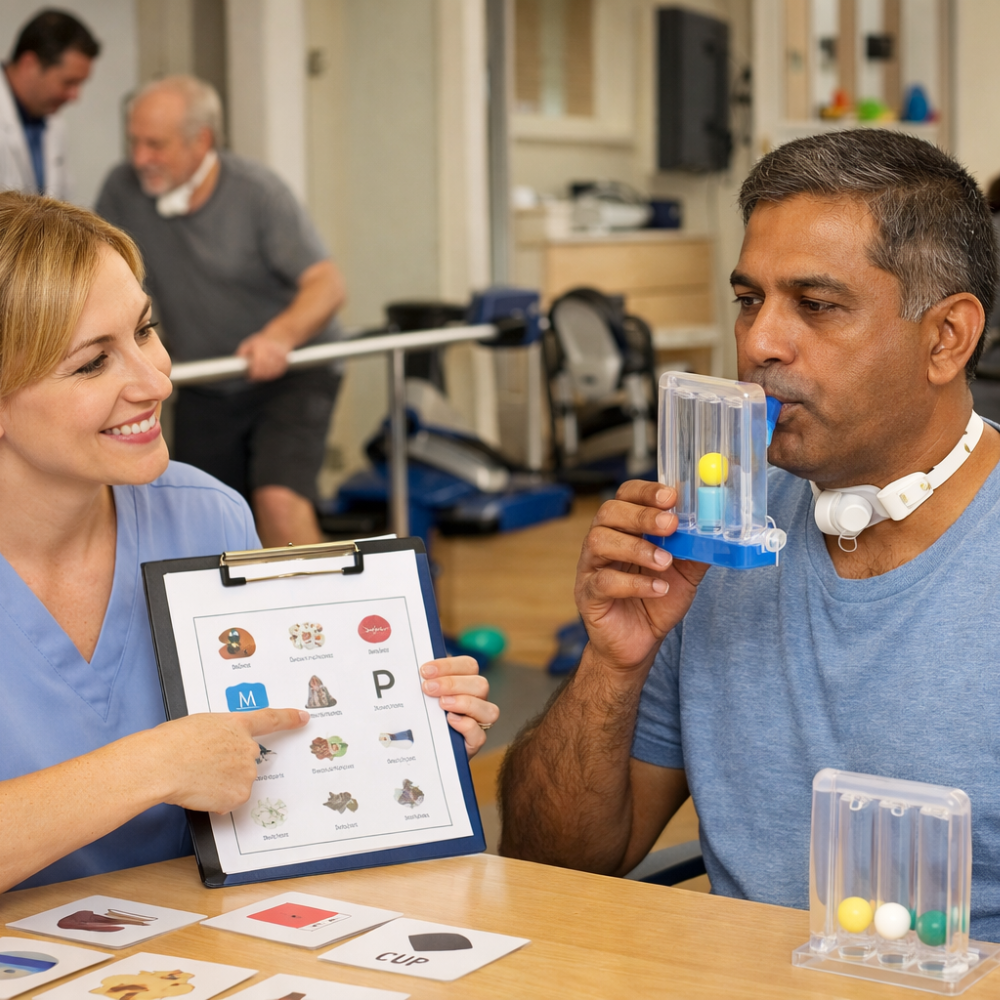
Patients with a tracheostomy often find one of their greatest fears come true; being unable to speak and communicate as they did before. Speech therapists tailor their services to address cross this hurdle, using particular techniques and special devices to acquire other ways of communicating.
Equally involved in rehabilitation is swallowing therapy. Some patients can find eating and drinking a difficult and often dangerous undertaking due to the risk of aspiration. The rehabilitation team employs a variety of strategies, exercises, and activities to help patients regain the ability to swallow safely so they can eat by mouth as opposed to through a feeding tube.
Respiratory Therapy
The focus of respiratory therapy is to strengthen the lungs and to improve the efficiency with which the patient can breathe. These consist of breathing exercises, chest physiotherapy, and sometimes the administration of supplemental oxygen.
Patients experience increased lung function as well as a reduced reliance on medical devices with consistent effort they can regain their ability to breathe on their own.
Home-Based Rehabilitation in Banjara Hills
Benefits of Home Care Services
Home-based rehabilitation is a new and innovative service being offered in Banjara Hills. It’s the first of its kind in the area, and the services are designed to offer the patients value in a manner not offered by other services.
The reduction of stress on the patient greatly reduces the recovery time and associated risks, and with a huge familiar, safe environment, the likely recovery time decreases significantly. This is especially true with tracheostomy surgery patients who are at risk of cross contamination and infection in a hospital setting. Home care services greatly reduce the possibility of hospital-acquired infections. Function of Nursing Professionals
Home rehabilitation is supported by skilled nursing. They take care of everything from tube care to suctioning, monitoring vital signs, and complication prevention
In places like Banjara Hills, having qualified professionals is a privilege. These trained individuals also guide family members, empowering them to participate in the rehabilitation process more actively.
Routine Care for Tracheostomy Patients
Routine Cleaning to Avoid Infection
Cleaning to afford infection and ensure the tubing of the tracheostomy continues to function had the following components:
- Cleaning the stoma
- Changing dressings
- Cleaning and sterilizing the tools
- Replacing inner cannulae
- Cleaning inner cannulae
Keeping the routine is greatly important. Missing one cleanup increases the risk of infection.
Watching for Complications
Infections can happen and it is the care giver's job to watch for the following symptoms:
- Red swelling
- Irritation and swelling
- Shortness of breath
- Thick mucus or other coloured substances
- Patients themselves can report fever or other signs of infection
Detecting infections early will allow less serious infections to be treated without hospitalization.
What You Need to Care for Tracheostomy Patients
Necessary Medical Equipment
In order to do the rehabilitation at home, medical equipment must be obtained. Most care takers have the following supplies:
- Suction Machines
- Humidifiers
- Sterile gloves
- Cleaning supplies
- Spare tracheostomy tubes
- Backup tubes for the tracheostomy
- Emergency contact numbers
- Portable oxygen
- Trained healthcare staff
- Individual treatment strategies
- Continuous staff support
- Good feedback from previous patients
- Foods that are softer and easier to be swallowed
- Foods that are richer in protein and include plenty of fluids
- How long does tracheostomy rehabilitation take?
It can take anywhere from a few weeks to several months as it depends on the individual patient. - Can tracheostomy patients speak normally again?
Patients can communicate normally again after completing speech therapy and receiving special tools. - Is rehabilitation in a hospital better than rehabilitation at home?
In-home rehabilitation is more comfortable and offers more individualized care. - What can happen if you don’t take care of a tracheostomy the correct way?
Not giving adequate care can cause serious complications like infections and blocked airways. - Are rehabilitation services in Banjara Hills expensive?
There is a range of prices, as many providers have different packages to fit most budgets.
Having the medical supplies will allow the
care giver to provide the routine care and manage the emergencies.
Prepared for Emergencies
Infections and other emergencies can happen at any time. It is especially important to prepare for emergencies. Care givers must have the following available:
When emergencies arise, acting quickly can result in saving lives.
Selecting a Rehabilitation Center Available at Banjara Hills
What Is Important
Your recovery hinges on making the right choice, so consider the following:
Your provider should be a reliable source for uninterrupted and outstanding support.
Price and Reach
While the healthcare system in Banjara Hills is of the highest quality, it is necessary for providers to be economical as well. To some extent, the rehabilitation hospitals have devised a number of flexible schemes.
Here is a rapid overview:
| Feature | Home Care Services | Hospital Rehab |
|---|---|---|
| Comfort | High | Moderate |
| Cost | Flexible | Expensive |
| Infection Risk | Low | Higher |
| Personal Attention | High | Limited |
Issues Faced in Tracheostomy Recovery
Risk of Infection
Infections pose significant problems with recovery, and while regular monitoring and cleaning may reduce the problems, they must be done carefully.
Difficulty Communicating
Many patients may find it difficult to communicate due to the device and may become frustrated as a result. In addition to speech therapy, there may be a variety of other communication support technologies to stimulate recovery.
Adjusting Nutrition and Daily Activities
Instructions Regarding Diet
Recovering from surgery means that some adjustment in diet is necessary, and aiming to incorporate the following nutrients and food types will support recovery:
In addition to the rehabilitation team, dieticians collaborate to craft a bespoke plan to reach the goals.
Instructions Regarding Physical Activity<.
When instructions are followed, some activity will hasten recovery, even from as far back as the muscular deconditioning that accompanies bed-rest due to illness. This may include mobilizing the patient.
Final Thoughts
Rehabilitation in tracheostomy support is not only medical treatment; there is a struggle to be able to live and get on with everyday activities in a normal manner. Personalized treatment plans to streamline recovery, as well as novel, dedicated, and personal care assist patients to recover on and regain everyday activities. Supported and trained to the standards of modern medical practices, and with the will of the patient to get better, independence becomes attainable and life, even enjoyable, may be achieved once more after the challenges that must be faced are overcome. Each assigned step brings the patient closer to relaxation.