Emergency Contact: +91 910 002 2202

Amputee Rehabilitation Centre in Banjara Hills
Amputee Rehabilitation Centre in Banjara Hills
20-11-2026Amputee Rehabilitation Centre in Banjara Hills
Experiencing an amputation changes the lifestyle of a person both physically and emotionally. There are many reasons why an amputation occurs such as an accident, infection, and complications from diabetes or other medical conditions. It requires a lot of patience, guidance and the right rehabilitation support to get through the recovery process. Even if an individual feels uncertain or nervous about things like walking, maintaining balance or returning to work, it is possible to become confident and fully independent to perform those activities through rehabilitation. If you are seeking an Amputee Rehabilitation Centre in Banjara Hills, you are in the right place.
Being fully independent isn't the only aspect of rehabilitation. There are many other problems that a person must deal with after losing a limb such as physical discomfort, restlessness, gait instability and the challenges of integrating into society. A good rehabilitation program takes into consideration factors such as the person's reason for amputation, the level of amputation, condition of the body and personal goals. Rehabilitation helps an individual reach a point where they can freely achieve goals such as full independence and confidence to perform everyday activities or returning to work. It also helps individuals improve other aspects of their life such as being active in the family and social environment again.
People and families looking for specialized healthcare in a proper location like Banjara Hills in Hyderabad will find a good amputee recovery and rehabilitation center. The best way to identify a center that understands the stages of amputee recovery is by visiting an amputee rehabilitation center. The center should have a multidisciplinary team made up of healthcare professionals who are involved in the assessment, training and ongoing management of the patient’s prosthetic device and mobility needs. The service should be available on a continuous and ongoing basis to guide the patient on the best ways of using the prosthetic device and maintaining the mobility status.
Understanding Amputee Rehabilitation
What Is Amputee Rehabilitation?
Amputee rehabilitation focuses on improving a person’s physical functions and ability to perform activities of daily living (ADLs) safely, independent of any aid. The process incorporates several disciplines of rehabilitation including prosthetics, physiotherapy, occupational therapy and psychology. It mainly aims at enhancing a person’s level of independence and abilities to perform various daily living activities to the best of their capability. Amputee rehabilitation focuses on the rehabilitation of the whole individual rather than the amputated body part. However, there are other challenges related to limb loss that amputee rehabilitation should address. The challenges include weakness of the remaining part, balance, ambulation, moving and using the prosthesis among others.
A professional Amputee Rehabilitation Centre in Banjara Hills begins with an individual assessment to understand the patient’s physical condition and their requirements for rehabilitation. Healthcare professionals assess muscle strength, range of motion and flexibility, posture, balance and mobility. They may also assess the status of the residual limb and identify pain and discomfort. They may also identify abnormalities that need immediate medical attention. Based on the assessment, the healthcare team develops a rehabilitation plan with goals that are realistic and measurable. Treatment goals are individualized and may vary based on the level of amputation, i.e., someone with an amputation below the knee may require different rehabilitation and prosthetic training than someone with an amputation above the knee or with an amputation of an upper extremity. The plan is frequently updated to reflect the patient’s ability to participate in the treatment.
The Importance of Rehabilitation After Amputation?
Amputations are considered to be major surgery and lead to many physical changes. The body takes time to adapt to changes in weight and balance, muscle activation and movement. The body also takes time to adapt to the loss of a body part. If a person does not have adequate rehabilitation, they may experience difficulty with activities of daily living, motor skill activities, and balance. If rehabilitation is not adequate, it can slow the recovery process. Rehabilitation should help the patient gain strength, stability, coordination, and movement.
Another benefit is learning the proper use of an artificial limb, if a prosthesis is appropriate. Using a prosthetic device does not mean that walking or other activities are immediately easy. Patients must learn to use the device by distributing their body weight and maintaining balance in new and different ways. They must learn to perform activities with a different movement pattern. This process is called learning new motor skills, and physical therapists and prosthetists guide patients through it. Prosthetic rehabilitation includes learning how to care for and protect the residual limb, how to detect skin problems that may occur with the limb, and how to maintain the prosthetic device. International rehabilitation recommendations indicate the importance of incorporating prosthetic rehabilitation, emotional care and physical mobility in the recovery plan of an individual.
Common Reasons for Limb Amputation
Amputation Due to Diabetes and Vascular Conditions
Uncontrolled blood sugar can damage nerves and blood vessels. With nerves damaged, an injury may not be felt and may go unnoticed. Improper healing of a cut or blister may lead to an infection which can potentially result in the loss of a foot. This is sometimes referred to as 'diabetic foot'. With poor blood flow to the feet due to peripheral arterial disease, wounds will not heal. This accumulates and leaves the foot with damaged and/or infected tissue. In severe situations, doctors will not be able to medically repair the infected/damaged tissue and the limb may need to be amputated. The removal of the limb may be necessary to protect the overall health of the person. The decision is made after careful consideration from the health care team treating the person.
Aside from improving mobility, rehabilitation also focuses on proper management of blood sugar levels. This is particularly important for people with diabetes. Education on proper foot and limb care and maintaining skin integrity is also crucial to prevent further complications. Rehabilitation helps the individual and family reinstate healthy routines and learn medical recommendations to manage diabetes. A specialized rehabilitation program also supports the individual to improve independence.
Accidents, Injuries and Medical Conditions
Some people mistakenly believe that the only reasons people lose limbs are diabetes or poor circulation. But severe trauma, burns, industrial accidents, workplace accidents and road accidents can also cause limb loss. Infections, bone abnormalities, tumors and other conditions may result in a surgical amputation. People who have a sudden loss may require more emotional support as they adjust to the physical changes, while others who have a planned medical amputation may be more prepared and informed of the process.
People who have had a planned medical or trauma amputation need a coordinated effort from the medical team to incorporate activities including wound care and pain management. Rehabilitation for amputees should include exercise to improve joint and muscle function. Early use of crutches or wheelchairs, or other assistive devices is important. As the wound heals, rehabilitation staff can evaluate when a prosthetic would be appropriate. Early goal setting and coordination between members of the rehabilitation team can assist in planning for an amputee's recovery.
Services Offered by an Amputee Rehabilitation Centre in Banjara Hills
Amputee rehabilitation should take into account the numerous limb loss-related conditions and discrepancies. There is no one-size-fits-all treatment. The right combination of treatments should take into account the amputee’s level of limb loss, medical condition, healing and progress, and individual goals. True professional rehabilitation is the integration of physiotherapy and prosthetic care, complemented by mobility training and ongoing support. Through integration of these services, amputees can be educated and assisted to overcome physical challenges, as well as how to functionally overcome challenges of day to day living. Those interested in amputee rehabilitation in Banjara Hills are advised to familiarize themselves with the services offered to facilitate their selection of the most appropriate center.
Physiotherapy and Physical Rehabilitation
Improving muscle strength and flexibility and joint movement is essential to amputee rehabilitation. After limb loss, muscular atrophy is common due to the lack of use of the muscle. Likewise, the joints surrounding the site of amputation may stiffen due to lack of use and extreme positioning. A physical therapist assesses the patient’s condition and outlines a course of treatment to assist in range of motion, strengthening and movement. An amputee is able to achieve daily functioning through active physical activity, rather than relying on others to assist them.
Physical rehabilitation makes some patients ready to use prosthetics. This is because the use of prosthetics may require some strength and endurance of related musculature and could thus benefit from rehabilitation. A case in point is a person with lower limb loss who is preparing to use a prosthesis. Rehabilitation would include strength training of the abdominals and the hip region to improve core strength and stability. This would also support functioning of the lower limb. Rehabilitation of persons with upper limb loss would require strengthening of the shoulder muscles to enhance the function of the arm and improve the efficiency of arm movement. This would help in control of the arm and movement of the trunk, as well as balance. The people may also learn how to do transfers including bed to chair, chair to wheelchair and wheelchair to car. All these may appear to be simple and basic, but they form the beginning and foundation of community reintegration and independent living.\
Assessing Prosthetics and Fitting Artificial Limbs
Prosthetic assessment is part of the service provided to people who may be candidates for an artificial limb. A prosthesis is a device made outside the body that helps to replace some functions of a missing limb. Current options for lower and upper limb prosthetics are designed to meet various levels of function, comfort and lifestyle needs. Some prosthetics are designed for general or basic limb function and movement, while others have more advanced features and functions. Each time a prosthesis is prescribed, various physiological and physical readiness assessments of the residual limb, including the shape, size and the condition of the skin and other tissues, as well as joint movement and muscle strength, are performed. Based on the outcome of the assessment, it is determined if the person is ready to use a prosthesis and, if so, what type.
The desired function is the most important factor in the selection of a prosthetic device. Other key factors for successful function of the prosthetic device include proper fit and alignment of the prosthetic socket, weight distribution and comfort. A prosthetic device that is ill fitting may cause skin irritation and movement discomfort. Follow up care and frequent adjustments are necessary to ensure an optimal fit. A thorough fitting and instruction class helps a person learn how to use the device safely and achieve effective function.
Gait Training and Balance Exercises
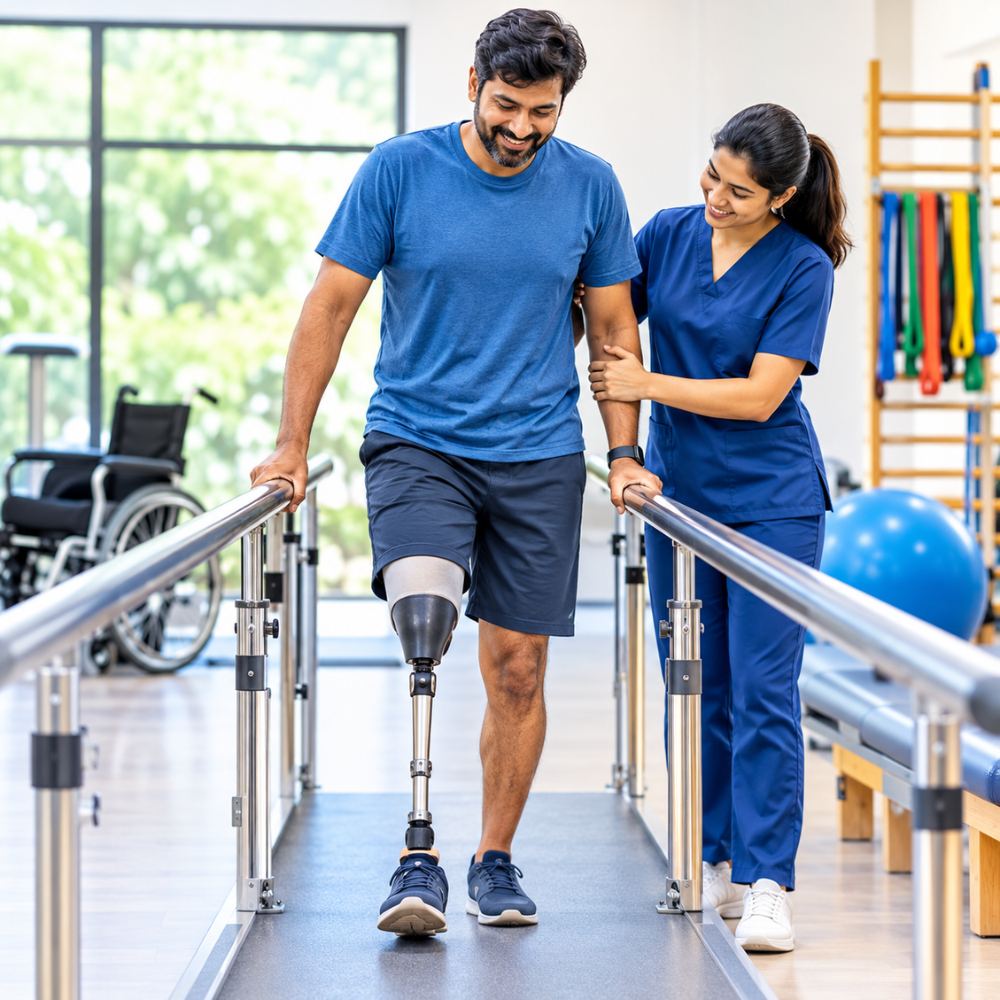
Gait training aids the process of safely and efficiently modifying a patient’s gait after limb amputation. Walking with a prosthetic limb involves the body learning and adapting to new movements as the prosthetic limb does not act or function the same way as a natural limb. Patients often feel apprehensive standing, shifting their weight and taking the initial steps. A therapist works with the patient to help the patient improve the coordination of the prosthetic and natural limb. A therapist will work with a patient to perform progressive exercises that begin with the patient standing and moving to walking, turning and using different surfaces.
Balance exercises are as important as gait exercises because of how limb loss impacts weight distribution and body’s ability to maintain stability. Therapists work with patients to improve control, posture and weight shifting. The therapist may introduce walking aids and parallel bars to assist and support the patient. The goal of therapy is to improve the patient’s ability to function independently and perform everyday tasks. This may include navigating gentle slopes and walking short distances.
Pain Management and Residual Limb Care
Management of pain is an important aspect of amputee rehabilitation as individuals can experience pain and/or discomfort in several ways after undergoing amputation. Some individuals experience pain in the residual limb. Others experience sensations in the absent or “phantom” limb. These phantom limb sensations can vary from tingling to pressure to even pain. Phantom limb sensations can also occur in the presence of pain in the residual limb. The intensity of these symptoms can vary. They can even impact an individual’s ability to sleep and affect their mood. If pain becomes unmanageable, individuals should consult their physician as there are several ways to effectively manage pain.
Care of the residual limb is important to maintain the health of the skin and prevent complications. It is important for an individual to know how to perform skin checks, maintain cleanliness of the residual limb, and identify signs and symptoms of problems like breakdowns, wounds and edema. A healthcare professional may also instruct the individual on positioning and/or the use of special types of dressing and compression to reduce swelling. It is also important to check for problems related to the use of a prosthesis. Healthcare professionals and rehabilitation centers should teach patients and their caregivers how to perform residual limb care to prevent complications and maintain a healthy residual limb.
Stages of Amputee Rehabilitation
Rehabilitation of amputees is often structured around a series of stages. The timing of the process is flexible and depends on the needs of the amputee. Rehabilitation can begin prior to the amputation surgery, and continue throughout the healing process, physical conditioning, training with a prosthesis, and lifelong maintenance of function. Healing, conditions, and abilities vary among amputees and, as such, not all amputees progress through the stages at the same rate or in the same order. Some will achieve sufficient function to progress to prosthetic walking, while others may not, and would benefit from alternative means to achieve independence and mobility, e.g. the use of a wheelchair. Rehabilitation professionals modify treatment in response to an individual’s progress and needs.
Early Post-Surgical Rehabilitation
The beginning of early post-surgical rehabilitation occurs when the surgical team has determined that the patient is stable enough for the next step in the healing process and rehabilitation. The primary goals at this stage are to assist the healing process, avoid/prevent complications, and maintain and improve joint mobility. There are a number of challenges that the patient must contend with as they begin their rehabilitation process. These challenges include swelling, pain, fatigue, and difficulty changing positions. The rehabilitation team sets goals with the patient that are aligned with medical instructions and focus on safe functional activities of daily living (ADLs). During this early stage of the rehabilitation process, the patient may learn how to transfer, and move about in bed, and use a wheelchair. The goal is to minimize the burden on the healing area by safely participating in daily activities.
Preventing joint stiffness and muscle shortening is yet another objective during the early stages of recovery. If a person remains in a particular position for a long time, the muscles and joints in that position may gradually become tight. As a result, moving the joints may become more and more difficult. The physiotherapist will recommend various positioning techniques and exercises to maintain joint flexibility and mobility. The patient may also learn protective positioning for the residual limb and methods to avoid excessive pressure which may affect the healing of the limb. Other family members need to understand the importance of following the recommendations of the professionals, instead of doing unfamiliar exercises and/or forms of massage. A gradual and carefully supervised approach creates a better basis for the next step in the rehabilitation.
Pre-Prosthetic Rehabilitation
Preparing a patient physically and functionally to use an artificial limb is known as pre-prosthetic rehabilitation. Prior to a prosthesis being fitted, the healthcare team must ensure that the residual limb has fully healed, and that the individual is mentally and physically prepared to use a prosthesis. During this time, patients undergo physical therapy to increase strength, flexibility, and cardiovascular endurance. They also practice using a wheelchair and safe mobility aids, transfers, and standing activities. Practicing these skills allows individuals to become mobile and functionally independent while using a prosthesis and, in the meantime, give them other mobility and function aids while they adjust to a new prosthetic device.
Management of the residual limb must also be addressed. Patients are taught methods to control swelling of the residual limb, and proper compression techniques to prepare the limb for the prosthetic assessment. The healthcare team may assess the patient’s emotional readiness for a prosthetic aid based on the patient’s ability to understand and prepare for a change in body image and confidence. The patient is given opportunities to discuss and understand what the use of a prosthesis will mean for them, and set expectations for what the prosthetic aid will do for them, and what it will not do for them. This process is meant to provide the patient with the tools for a comfortable, realistic transition to using a prosthetic aid.
Prosthetic Training and Mobility Development
Upon a patient receiving a prosthesis, they begin training under the supervision of a professional. Initially, they learn how to put on and take off the prosthesis and how to notice pressure and discomfort. They learn exercises on how to stand and shift their weight. They then learn how to walk. While learning how to walk and do various activities with the prosthesis, a therapist focuses on body positioning and movement technique and how the patient weighs their limbs. The patient should focus on the guidance given to them regarding their wearing time and not push themselves beyond what they are able.
Patients are able to begin training how to walk and function normally in their environments. They are able to gain the skills necessary to maneuver different surfaces. Training is focused on daily living activities. The aim of prosthetic training is to gain skills that enable the patient to participate in their daily activities.
Choosing the Best Amputee Rehabilitation Centre in Banjara Hills
Finding the most suitable rehabilitation center is of prime importance for amputee patients as well as for their family members. Not every center has the required advanced equipment, specialized knowledge and/or multi-disciplinary services required for effective amputee rehabilitation. Patients should first find out what level of amputation (upper or lower limb) and other recovery requirements they have and verify whether the center in question is equipped to address them. A good start would be to check the qualification and experience of the rehabilitation professionals, availability of prosthetic consultation, and the treatment methods and aids used during rehabilitation. It is important that patients verify how the center assesses and evaluates their progress and whether the rehabilitation program is individualized to the patient's own goals and preferences. Based on the answers to these questions, many amputee patients and/or their family members are able to make an informed decision beyond considering just the location of the facility or various advertisements.
One of the most important things patients consider is accessibility. For regular outpatient rehabilitation, amputee patients often need transport to and from the center, and the center should have convenient accessible access, seating and treatment arrangements. The center should also provide care and support to caregivers, describe the process of setting up an appointment, and the expected frequency of treatment. It is also important to know if and how the center coordinates prosthetic services, rehabilitation and follow-up services. For treatment, patients have the right to know the costs of treatment and assessment in advance. Any unexpected additional costs should also be explained. Having a clear and transparent policy helps patients plan their rehabilitation process.
Communication is crucial. Professionals should explain treatment goals using language the patient can understand and demonstrate exercises in a similar manner. They should actively engage patients in their treatment and avoid absolute statements regarding the patient’s recovery. A reliable facility understands that patients are at different stages of the process and encourages discussion regarding pain and mobility concerns. They keep family and caregivers apprised of the patient’s status and involve the patient in goal setting. The patient is given the opportunity to express the issues and concerns they have regarding their prosthesis.
Benefits of Professional Amputee Rehabilitation
There are many benefits to amputee rehabilitation. One of the most important benefits is improvement in functional mobility. Strengthening and flexibility of the joints can be worked on and practiced via balance exercises. This improves the individual’s ability to perform activities such as standing and walking, as well as assisting with transfers. Continued effort in specific activities strengthens the necessary muscles for performing activities of daily living. Constant practice helps the patient to become more mobile and meet their overall goal of independence. Use of a prosthetic limb requires the individual to learn the proper movement and techniques, as well as the correct usage of the device. The treatment is individually centered. This means the patient is worked on to reach their maximum capability and stage of recovery, and not compared to other patients.
More confidence is another benefit. People may become anxious about moving after amputation because they are afraid of falling, feeling pain, or further injuring their residual limb. Due to the supervision of a professional, they can learn to engage in various activities despite having a prosthesis. People can also learn to confidently interact in their family, social and working activities. Sometimes, caregivers also need rehabilitation to learn how to provide assistance to patients so they don't lose their confidence by limiting their independence. The balance between self-reliance and assistance can be learned by the patient through rehabilitation.
Being in a rehabilitation center allows early intervention when a problem is suspected. There, assessment of various things are often done to prevent problems or complications. Care needs of patients with diabetes or people with circulation related problems may be more and require more frequent assessment. If something is suspected to be wrong, the team can communication their concerns and worries to a medical practitioner and request for a consultation or review. Just like assessment, the long-term services helps patients adapt their prosthetic devices to their changing body conditions and activities. This makes services valuable because people can maintain their mobility and independence for life.
Conclusion
Identifying the right Amputee Rehabilitation Center in Banjara Hills can help patients restore physical strength and confidence after limb loss. Amputee rehabilitation is more than using a prosthesis. It is about using all the aids available in the amputee rehabilitation center for limb care, gait training, balance training, pain management, emotional support and many other activities to train the amputee for everyday living.
Every patient is different and has his or her own goals. An individualized rehabilitation program based on patient requirements is the best way to facilitate the patient in achieving his or her goals. The program should be designed by a specialized rehabilitation team and should be changed to accommodate the patient's progress. The desired improvement in one's mobility can be effectively achieved when the patient is committed and practices continuously under the guidance of specialized professionals and supports his or her family.
For someone who had limb loss, the right rehabilitation professionals are the best persons to explain and validate the treatments available. The focus should always be on amputee independence and a realistic outlook is the best way to achieve it.
FAQs
-
What is an Amputee Rehabilitation Centre in Banjara Hills?
An Amputee Rehabilitation Centre provides specialised rehabilitation, physiotherapy, prosthetic assistance and mobility training to amputees.
-
What treatments are there for amputees in Banjara Hills?
Treatments for amputees in Banjara Hills include but are not limited to, physiotherapy, muscle strengthening, balance training, prosthetic support and pain management.
-
Can amputees walk again with physiotherapy?
Yes, walk again with the help of physiotherapy.
-
How long will amputee rehabilitation take?
A patient's health and progress determines how long amputee rehabilitation will take.
-
How do I select the best amputee rehabilitation centre in Banjara Hills?
Choose a centre that has qualified professionals, provides individualised care and prosthetic assistance, and has regular follow up care.